Discover how AI data agents and governance-first conversational analytics redefine BI, with a three-layer architecture, a practical three-week pilot, and measurable ROI.
Why AI Data Agents Are Reshaping BI
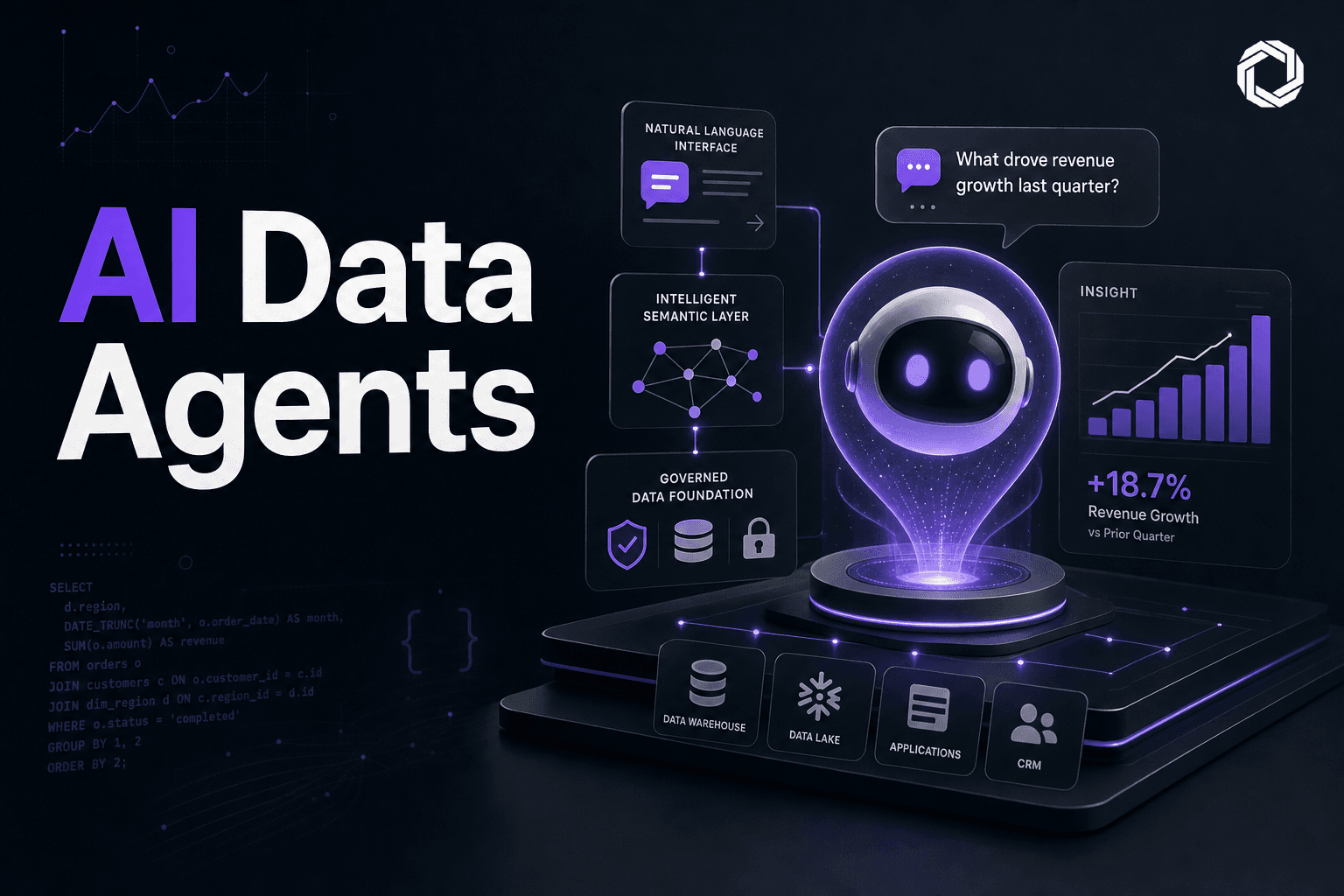
AI data agents are shifting how organizations interact with data—from static dashboards to dynamic, conversational analytics. Instead of waiting for scheduled reports, business users can ask natural-language questions and receive contextual, actionable answers. This shift is powered by multi-agent systems that combine four agent types to move from data to decision: data agents that surface trusted data, planning agents that align questions with business goals, insight-synthesis agents that fuse signals into meaningful insights, and action agents that trigger workflow changes or alerts. The idea is not simply faster answers; it’s a coordinated flow from data access to decision execution.
This evolution is widely discussed in industry discourse on AI-enabled BI. For a practical framing of how AI agents transform analytics, see best-practice discussions on conversational analytics and the role of distinct AI agents in delivering insights. Conversational analytics best practices.
When you map this against the typical BI lifecycle, you see a continuum: from data ingestion and preparation, through model-context-aware interpretation, to proactive recommendations and automated actions. Modern BI analytics papers and practitioner guides emphasize that the real value comes when the conversational layer is anchored to trustworthy data and governed workflows. See foundational perspectives on how AI agents reshape analytics and what it takes to scale responsibly. AI agents vs traditional BI and the broader AI-driven BI conversation in industry coverage. Business Intelligence Analytics: a complete guide for the AI era.
Readers should also consider how conversational analytics looks in practice—beyond speed to insight. Zenlytic’s overview of what conversational analytics enables in real-world teams illustrates the practical benefits and the need for governance as a cornerstone of trust. What is Conversational Analytics? Benefits, Use Cases.
Gaps in Current Coverage
Most coverage highlights speed, convenience, and the novelty of AI agents. Yet, in real-world deployments, gaps appear in areas that matter most for enterprise credibility and risk management:
- Governance and data quality: Without strict data quality controls, provenance tracking, and clear data ownership, conversational answers risk being inconsistent or misleading. Governance, provenance, and explainability are foundational to trust in AI analytics and are repeatedly underscored in practitioner guidance. See how governance is framed within AI-enabled analytics in industry analyses. AI Agents vs Traditional BI.
- Privacy and security: Cross-source orchestration must respect data privacy regimes and access controls, especially as conversations span multiple data domains.
- Change management: The fastest adoption requires disciplined change management, training, and guardrails so users know when to question or escalate outputs.
- Cross-source orchestration and lineage: Real-world BI harnesses data from many sources; missing lineage and cross-source governance undermine confidence in insights.
- Explainability and trust: Stakeholders demand explainable outputs, especially when actions may have regulatory or financial consequences. See industry discussions on the importance of governance and explainability in AI analytics. Conversational Analytics: Best Practices for AI Agents.
Recognizing these gaps is essential before faster, conversational analytics become a trusted business capability rather than a flashy feature.
A Governance First Framework for AI Data Agents
To address these gaps, we propose a three-layer governance-first framework that aligns data, agents, and actions with clear guardrails and measurable controls. The three layers are:
Layer 1 — Data Quality and Provenance
- Data contracts and quality rules that codify expectations for accuracy, freshness, completeness, and lineage.
- Provenance tracking to capture source, transform, and access history for every data artifact used by agents.
- Access controls and privacy safeguards that enforce role-based permissions and data minimization.
Layer 2 — Agent Orchestration and Context Management
- Orchestration of multiple agent types (data, planning, insight-synthesis, action) to ensure coherent workflow and avoid conflicting recommendations.
- Context management that preserves business intent, model context, and user identity across sessions and data domains.
- Guardrails for model outputs, including confidence levels, traceability, and audit trails.
Layer 3 — Insight to Action Governance
- Guardrails that govern when and how insights trigger actions, with escalation paths for ambiguous results.
- Explainability and traceability of decisions, including model context protocols and output provenance.
- Risk management and compliance checks that align with regulatory requirements and data privacy laws.
Metrics to track across the three layers include data lineage completeness, explainability scores, access control effectiveness, and risk posture indicators. This governance-first stance is widely echoed in industry discussions of AI-enabled analytics and the balancing act between autonomy and control. See how governance is framed in AI agents versus traditional BI and the role of governance in hybrid AI systems. AI Agents vs Traditional BI.
Implementation Blueprint
Below is a high-signal blueprint you can adapt to your data fabric and regulatory constraints. It is designed to be vendor-neutral and actionable at enterprise scale.
- Inventory data sources and map data contracts: Identify all data sources used by analytics conversations, including sensitive domains. Establish data contracts that codify schema, quality, privacy requirements, and ownership. (Internal alignment with data engineering teams is essential; see our recommended collaboration touchpoints in the pilots.)
- Design conversation context: Define what constitutes business context for the analytics to ensure the right data is surfaced and the right questions are asked. Establish guardrails for topic scope and sensitive content.
- Configure monitoring and governance: Enable lineage tracking, explainability dashboards, and audit logs for agent outputs and actions.
- Define success metrics: Create both process metrics (time-to-answer, guardrail hits) and business metrics (time-to-decision, accuracy of recommendations, ROI impact).
- Run a pilot and plan scale: Run a focused pilot to validate governance controls, measure ROI, and refine guardrails before broader roll-out.
Implementation considerations are grounded in existing best practices for AI-enabled analytics and governance-focused design. See how BI analytics and AI-era guidance describe evolving roles and processes for analytics teams. Business Intelligence Analytics: A Complete Guide for the AI Era.
Use Cases Across Industries
Across industries, governance-first conversational analytics unlocks measurable improvements in customer experience, supply chain, finance, planning, healthcare, and retail. Consider the following typical before/after scenarios:
- Customer experience: A contact center uses data agents to surface sentiment signals, with planning agents proposing next-best actions. Guardrails ensure data access only to approved customer data domains, and explainability traces are available for compliance reviews.
- Supply chain: Orchestrated data sources reveal real-time inventory risk; action agents automatically trigger replenishment workflows with approval gates.
- Finance and planning: Forecasts are generated via insight-synthesis agents, with governance layers ensuring data lineage, privacy, and model context for regulatory audits.
- Healthcare and retail: Patient privacy rules and PCI-like protections govern data access; cross-domain analytics enable more effective care coordination and merchandising decisions.
These scenarios illustrate how governance-first AI agents can deliver measurable improvements in decision speed, accuracy, and risk management. See practical case materials and case studies in industry sources on conversational analytics and AI-driven BI. What is Conversational Analytics? Benefits, Use Cases.
Measuring ROI and Managing Risk
A governance-first program focuses not only on speed but also on the quality and trustworthiness of insights. Key KPIs include:
- Time-to-insight and time-to-action reductions
- Data lineages completed and trusted data utilization rate
- Guardrail compliance rate and explainability coverage
- Reduction in analytic incidents due to incorrect outputs
- ROI timelines and first-year impact estimates (cost savings from faster decision cycles, avoidance of errors, and incremental revenue opportunities)
Risks to monitor include hallucinations or misleading outputs, governance gaps in cross-source contexts, regulatory compliance violations, and privacy exposures. Industry guidance emphasizes that when governance is embedded in AI analytics from the start, ROI realization accelerates and risk exposure decreases. See discussions on governance and hybrid AI approaches. AI Agents vs Traditional BI.
Getting Started: The 3 Week Pilot Playbook
A compact, actionable pilot plan helps teams demonstrate governance-first AI analytics with minimal risk and clear milestones. A 3-week framework can be used as a starting point and then scaled:
- Week 1 — Data contracts and context design: inventory data sources, publish data contracts, define initial guardrails, and establish data owner responsibilities. Validate lineage mapping for critical datasets and document access controls.
- Week 2 — Guardrail tuning and monitoring: deploy initial guardrails for explainability, privacy, and access control; set up dashboards to monitor guardrail hits, data quality metrics, and agent outputs.
- Week 3 — Impact assessment and handoff: measure time-to-insight, accuracy of outputs, and user adoption; prepare a scale plan, with a governance playbook and templates for contracts, guardrails, and dashboards ready for rollout.
If you’d like a ready-to-use starter kit, we provide templates for data contracts, guardrails, and impact dashboards to accelerate your own pilot. In addition, a strategy session can help tailor the plan to regulatory requirements and existing data fabrics. See our related governance-focused engagement options and templates in the resources section.
Templates, Checklists, and Performance Dashboards
To accelerate adoption, consider templated artifacts:
- Data contracts template (JSON/YAML) and a guardrails specification (YAML)
- Guardrail tuning checklist and a monitoring dashboard blueprint
- ROI calculator and KPI dashboards to track progress over the pilot and into scale
A governance-first pilot should be complemented by hands-on guidance from your data and security teams, with AI readiness assessment and architecture reviews to ensure alignment with your regulatory and architectural constraints.
Next Steps and Resources
If you’d like to discuss tailoring this governance-first blueprint to your organization, schedule a strategy session. We can customize a three-layer architecture, align on data contracts, guardrails, and a pilot plan, and provide templates and dashboards to accelerate adoption. For deeper exploration, see related internal capabilities and services such as architecture review, data engineering, security-aware-engineering, and AI readiness assessment.
Internal resources and external references are essential to grounding practical execution. The following external sources provide context and practical perspectives on AI agents, governance, and conversational analytics, which inform this governance-first approach:
- AI agents vs Traditional BI — GoodData
- Conversational analytics best practices — Wisdom
- BI analytics in the AI era — Databricks
- What is Conversational Analytics? — Zenlytic
For reader-specific next steps, we offer a complimentary 60-minute strategy session to assess readiness, download the governance-first pilot playbook, and initiate a 3-week pilot.
Internal links: