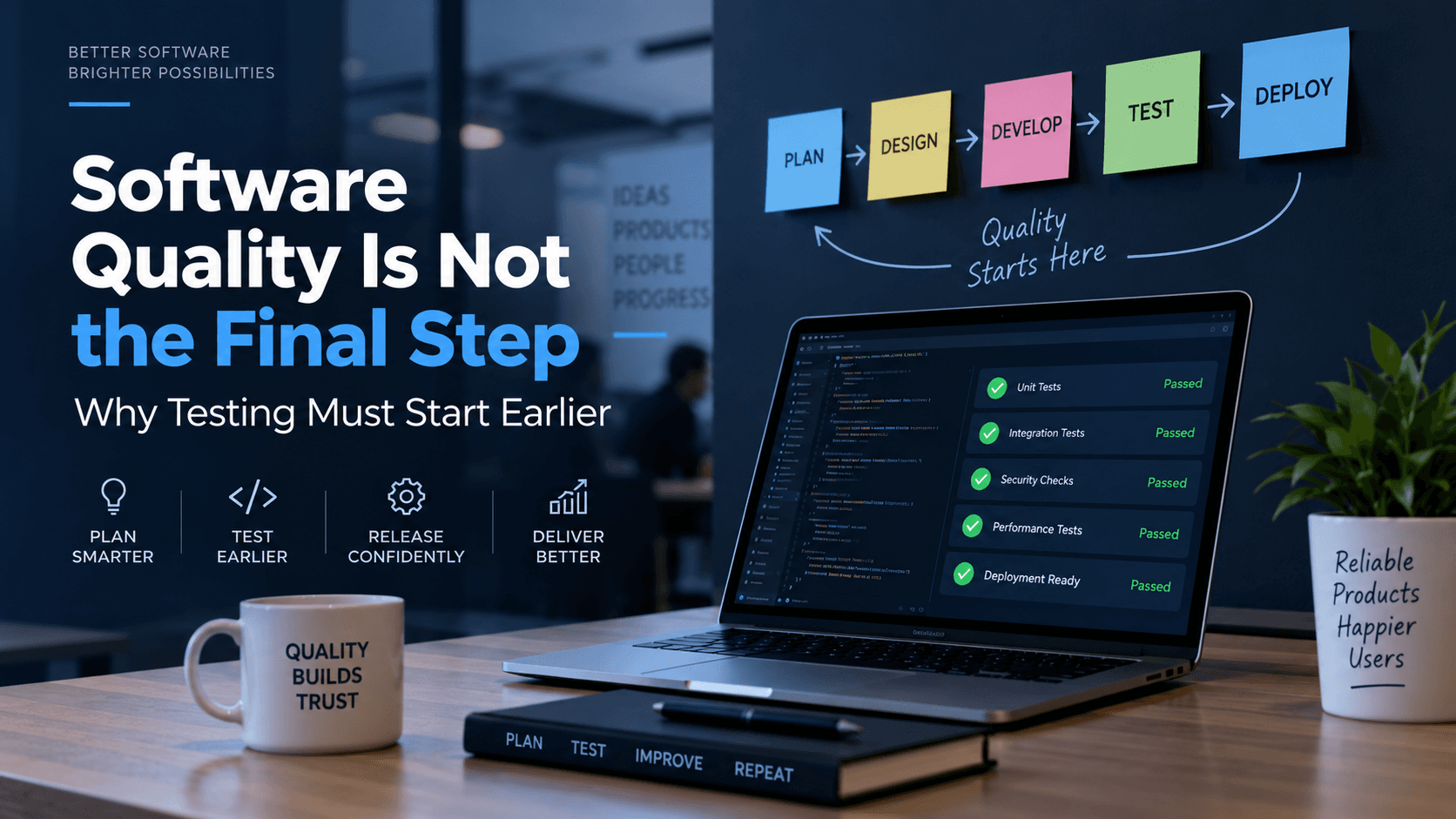
Software quality is more than final-stage testing. Learn why early testing, automation, security, and monitoring help teams build more reliable digital products.
What Does Software Quality Really Mean?
Software quality is broader than whether an application contains bugs.
A high-quality product should work correctly while also delivering a reliable experience.
Quality can include:
- Functional correctness
- Performance
- Reliability
- Security
- Accessibility
- Usability
- Maintainability
- Compatibility
- Scalability
A product may technically work but still provide poor quality.
For example, an application may complete a transaction correctly but take too long to respond.
Another product may perform well but expose users to security risks.
Quality therefore needs to be considered across the complete product experience.
Why End-of-Cycle Testing Falls Short
Traditional development processes often leave testing until most development work is complete.
This creates a major problem.
When defects are discovered late, the team may need to revisit:
- Requirements
- Design decisions
- Application logic
- Database structures
- APIs
- Integrations
- User interfaces
A single problem can affect several areas of the product.
Late testing can also create pressure before release, leading teams to choose between delaying deployment and accepting known risks.
Testing earlier helps reduce this pressure.
The Cost of Finding Bugs Too Late
Not all bugs have the same impact.
A small visual issue may be easy to fix.
A deeper architectural or data problem can require significant rework.
Late defects may lead to:
- Delayed releases
- Additional development work
- Production incidents
- Customer frustration
- Emergency fixes
- Increased support requests
- Revenue impact
The longer a problem remains undiscovered, the more systems and features may be built around it.
Finding issues earlier helps teams correct problems before they become deeply embedded in the product.
Quality Starts With Product Design
Testing should not begin only after developers write code.
Many quality problems begin much earlier.
Unclear requirements, incomplete user flows, ambiguous business rules, and unrealistic assumptions can eventually become software defects.
Teams can improve quality during planning by asking:
- What should happen in unusual situations?
- What happens when required data is missing?
- What happens when an external service fails?
- What should users see when an operation cannot complete?
- What are the security requirements?
- What performance expectations exist?
Thinking about these questions early reduces uncertainty during development.
Quality therefore starts with clear product thinking.
Shift-Left Testing Finds Problems Earlier
Shift-left testing means moving testing activities earlier in the software development lifecycle.
Instead of waiting for a finished feature, teams test continuously as development progresses.
This can include:
- Requirement reviews
- Unit testing
- API testing
- Integration testing
- Code reviews
- Static analysis
- Security scanning
- Automated validation
Developers receive faster feedback and can correct problems while the relevant code is still fresh.
The objective is not to eliminate dedicated QA.
It is to make quality a shared responsibility across the engineering process.
Automated Testing Supports Continuous Delivery
Manual testing remains valuable, but it becomes difficult to rely on manual checks alone as a product grows.
Every new feature increases the number of scenarios that need validation.
Automated tests can repeatedly check important behavior.
Common automated testing layers include:
- Unit tests
- API tests
- Integration tests
- Regression tests
- End-to-end tests
- Performance tests
Automation becomes particularly important when teams use CI/CD.
Every code change can automatically trigger relevant tests before the software moves closer to production.
This helps teams detect regressions sooner and release changes more consistently.
Production Monitoring Is Part of Quality
Testing before release cannot reproduce every real-world situation.
Users may behave differently from test scenarios.
Traffic patterns can change.
External services can fail.
Infrastructure may behave unexpectedly.
This is why quality continues after deployment.
Monitoring and observability help teams understand:
- Application errors
- Response times
- Service availability
- Failed transactions
- Infrastructure health
- User-impacting incidents
Production data can reveal problems that were difficult to detect during testing.
This creates a continuous quality cycle:
Build → Test → Deploy → Monitor → Learn → Improve
Security and Performance Are Quality Requirements
A product is not high quality if it works correctly but is insecure or extremely slow.
Security and performance should therefore be included in quality engineering.
Security testing may include:
- Access-control checks
- Dependency scanning
- Vulnerability testing
- API security validation
- Authentication testing
- Configuration reviews
Performance testing may examine:
- Response times
- Concurrent users
- Database performance
- API latency
- Infrastructure behavior
- Resource usage
Treating these areas separately from QA can create blind spots.
Quality should reflect the complete behavior of the product.
Quality Directly Affects Customer Trust
Users may never see your testing strategy.
They experience its results.
Repeated crashes, failed transactions, slow pages, security incidents, and broken features can quickly reduce trust.
Poor software quality can affect:
- Customer satisfaction
- Retention
- Brand reputation
- Support workload
- Product adoption
- Revenue
Quality engineering therefore has a business impact.
Reliable products allow teams to release improvements with greater confidence while giving customers a more consistent experience.
Conclusion
Software quality should not be treated as the final checkpoint before release.
It should be part of the complete product lifecycle.
Quality starts with clear requirements and continues through design, development, automated testing, security validation, deployment, monitoring, and continuous improvement.
Teams that introduce quality practices earlier can identify problems sooner, reduce unnecessary rework, improve release confidence, and build more reliable products.
The objective is not to create software with zero defects.
That is rarely realistic.
The objective is to create an engineering process that detects problems early, limits their impact, and continuously improves product reliability.
For modern digital products, quality is not simply the responsibility of a QA team.
It is an engineering discipline shared across the entire organization.
How Techlusion Helps
Techlusion works across QA & Testing, Product Engineering, Custom Software Development, SaaS, Cloud & DevOps, AI systems, and Technical Leadership.
Our approach focuses on helping teams build reliable digital products through stronger engineering practices, testing, automation, performance validation, and continuous improvement.
Build Quality Into the Product
If testing only begins before release, quality problems may already be expensive to solve.
Building quality earlier helps teams ship with greater confidence and create software that remains reliable as products grow.