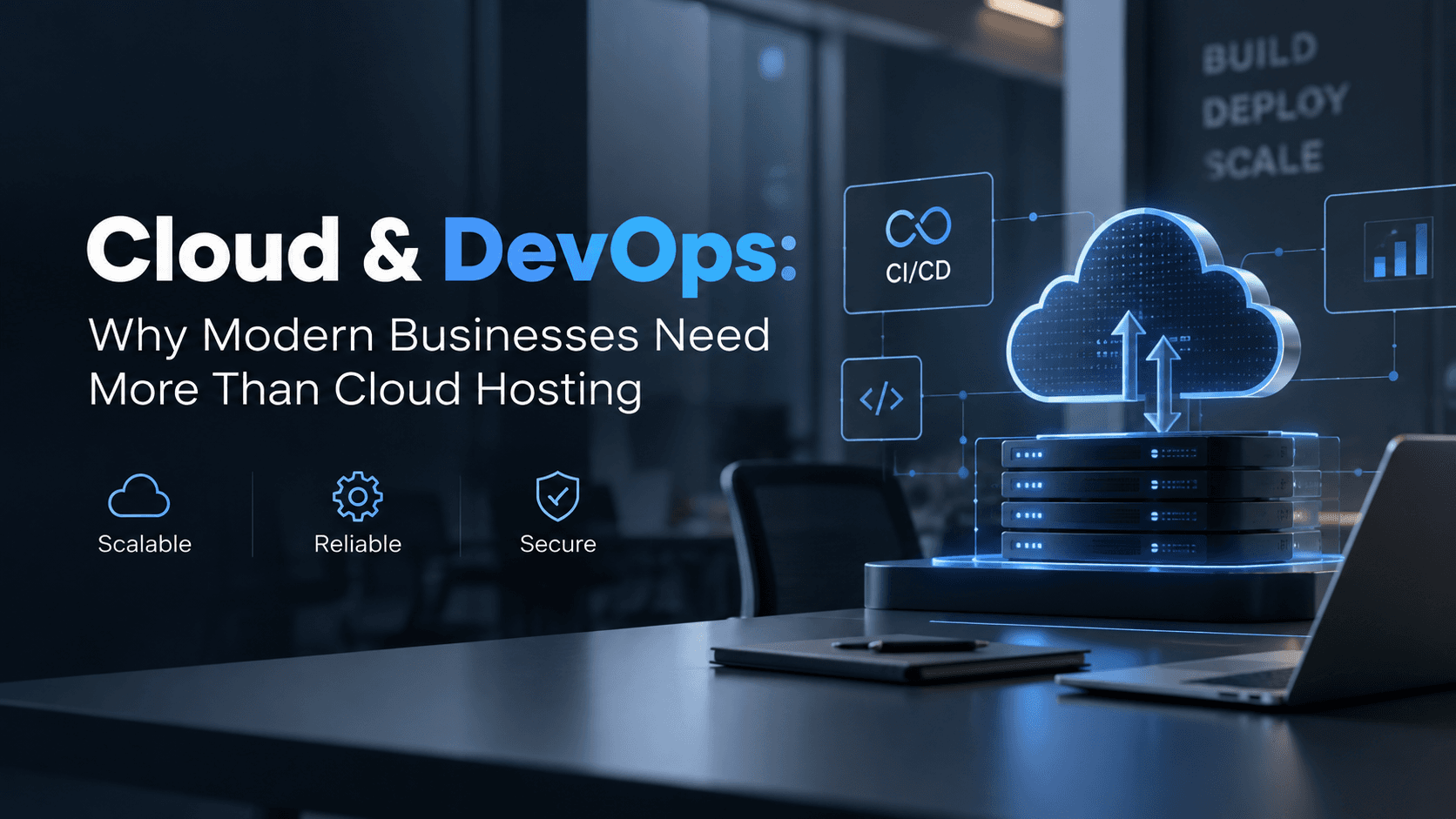
Cloud and DevOps help businesses scale applications, improve reliability, automate delivery, strengthen security, and manage infrastructure efficiently.
1. What Is Cloud Computing?
What Is Cloud Computing?
Cloud computing allows businesses to access technology resources over the internet instead of purchasing and maintaining all infrastructure themselves.
These resources may include:
- Computing power
- Storage
- Databases
- Networking
- Security services
- Application hosting
- Data processing
- Backup and recovery systems
- Managed software services
Cloud platforms also allow businesses to use resources based on demand. Instead of investing in physical servers that may remain underused, companies can increase or reduce capacity as their requirements change.
Key Benefits of Cloud Computing
Cloud infrastructure can help businesses achieve:
- Faster access to technology resources
- Flexible capacity
- Global application availability
- Reduced hardware management
- Easier disaster recovery
- Access to managed services
- More efficient infrastructure planning
However, these benefits depend on how the cloud environment is designed and managed.
An application can still experience downtime, security issues, performance problems, or unnecessary costs when its cloud infrastructure is poorly planned.
2. What Is DevOps?
DevOps is an engineering approach that brings software development and IT operations closer together.
It is not a single tool, platform, or job title. Instead, DevOps combines people, processes, automation, and technology to improve how software is developed, deployed, monitored, and maintained.
DevOps practices commonly include:
- Continuous Integration
- Continuous Delivery
- Infrastructure as Code
- Automated testing
- Deployment automation
- Monitoring and observability
- Security integration
- Incident response
- Infrastructure management
- Collaboration between development and operations teams
The goal is to create a more consistent and efficient software delivery process.
Rather than relying on manual handoffs and individual knowledge, DevOps helps teams create repeatable systems that support faster and safer delivery.
How Cloud and DevOps Work Together
Cloud platforms provide the infrastructure required to run modern applications.
DevOps practices help teams manage that infrastructure and deliver software more effectively.
A typical cloud and DevOps workflow may look like this:
Code → CI/CD Pipeline → Automated Testing → Cloud Infrastructure → Deployment → Monitoring → Feedback
This process allows teams to:
- Test changes before release
- Deploy software consistently
- Reduce manual configuration
- Detect problems earlier
- Roll back unsuccessful releases
- Improve collaboration
- Respond to changing business requirements
Cloud and DevOps are therefore not separate technology decisions. They work together as part of a broader approach to building and operating digital products.
Why Scalability Matters
An application that works well for a small number of users may not perform the same way when demand increases.
As a product grows, it may need to handle:
- More users
- More transactions
- Larger databases
- Increased traffic
- Additional integrations
- More frequent deployments
- Higher availability requirements
Cloud infrastructure can provide the flexibility required to support this growth. Resources can be increased during periods of high demand and reduced when demand falls.
However, scalability is not achieved simply by adding more servers.
A scalable system also requires:
- Efficient application architecture
- Proper database design
- Load balancing
- Caching
- Queue-based processing
- Automated resource management
- Performance monitoring
- Reliable deployment processes
DevOps helps make these practices repeatable through automation, infrastructure configuration, monitoring, and operational standards.
Reliability Is More Than an Uptime Claim
Reliability means more than keeping an application online under normal conditions.
Reliable systems are designed to handle unexpected events and recover from failures with minimal disruption.
Potential issues may include:
- Server failures
- Traffic spikes
- Database outages
- Network problems
- Application crashes
- Deployment errors
- Configuration mistakes
- Third-party service failures
Cloud and DevOps practices help businesses prepare for these situations through:
- Redundant infrastructure
- Automated backups
- Health checks
- Monitoring and alerts
- Disaster recovery planning
- Safe deployment strategies
- Rollback procedures
- Incident response processes
The objective is not to assume that failures will never happen.
The objective is to ensure that failures can be detected, managed, and resolved effectively.
Automation Reduces Operational Complexity
Manual infrastructure management may work for a small environment, but it becomes increasingly difficult as a business grows.
Manual processes can lead to:
- Configuration inconsistencies
- Deployment delays
- Human error
- Difficult troubleshooting
- Dependency on individual team members
- Unclear ownership
- Repeated operational work
DevOps automation helps reduce these challenges by standardizing repetitive processes.
Automation can support:
- Application deployments
- Infrastructure provisioning
- Environment configuration
- Automated testing
- Backup management
- Monitoring setup
- Security checks
- Scaling processes
- Recovery procedures
Automation does not eliminate the need for engineering expertise. Instead, it allows teams to spend less time repeating manual tasks and more time improving the product and infrastructure.
CI/CD Enables Faster Software Delivery
Continuous Integration and Continuous Delivery, commonly known as CI/CD, help teams release software in smaller and more controlled increments.
With CI/CD, code changes can be automatically:
- Submitted to a shared repository
- Tested for quality and functionality
- Checked for security or configuration issues
- Deployed to a staging environment
- Approved for production
- Released using a controlled process
This approach reduces the risks associated with large, infrequent releases.
Benefits of CI/CD
A well-designed CI/CD process can help businesses achieve:
- Faster feature delivery
- Smaller and safer releases
- Earlier bug detection
- More consistent deployments
- Easier rollbacks
- Reduced manual work
- Better collaboration between teams
CI/CD also creates a feedback loop. Teams can learn more quickly from each release and respond to customer or business requirements with greater speed.
Monitoring and Observability
Deploying an application is only one part of operating it successfully.
Teams also need to understand what happens after deployment.
Monitoring and observability provide visibility into application performance, infrastructure health, user experience, and system behavior.
They help answer questions such as:
- Is the application available?
- Are users experiencing errors?
- Which service is causing a delay?
- Is the database reaching capacity?
- Did a recent deployment create a problem?
- Is traffic increasing unexpectedly?
- Are cloud resources being used efficiently?
Monitoring and Observability Are Different
Monitoring typically focuses on known conditions, such as CPU usage, memory consumption, uptime, or error rates.
Observability provides deeper insight into why a system is behaving in a particular way. It commonly combines:
- Metrics
- Logs
- Traces
- Events
- Alerts
- Dashboards
Good observability helps teams identify problems earlier, investigate incidents faster, and make better infrastructure decisions.
Security Should Be Part of the Workflow
Security should not be treated as a final step after an application has already been developed and deployed.
Modern Cloud and DevOps practices integrate security throughout the software delivery lifecycle.
Important security considerations include:
- Identity and access management
- Role-based permissions
- Secret management
- Network security
- Dependency scanning
- Infrastructure configuration
- Vulnerability management
- Logging and auditing
- Deployment permissions
- Data protection
Security automation can help identify risks earlier and reduce the possibility of configuration mistakes.
When security is integrated into development and operations, teams can address issues before they reach production instead of relying only on post-release reviews.
Conclusion
Cloud hosting gives businesses access to flexible and powerful infrastructure.
However, infrastructure alone does not guarantee scalability, reliability, security, or operational efficiency.
DevOps provides the practices and automation required to manage cloud environments effectively. Through CI/CD, Infrastructure as Code, monitoring, observability, security integration, and cost management, teams can create a more reliable foundation for software delivery.
The real value comes from combining Cloud and DevOps as part of a broader technology strategy.
For companies building SaaS platforms, AI products, digital applications, and scalable software systems, Cloud and DevOps are no longer simply infrastructure decisions. They are essential parts of the product and business strategy.