Jev AI's System One model enables bounded, measurable decisions in enterprise apps with a practical architecture playbook for safe, governable AI decision workflows.
What Jev AI is and the System One primitives
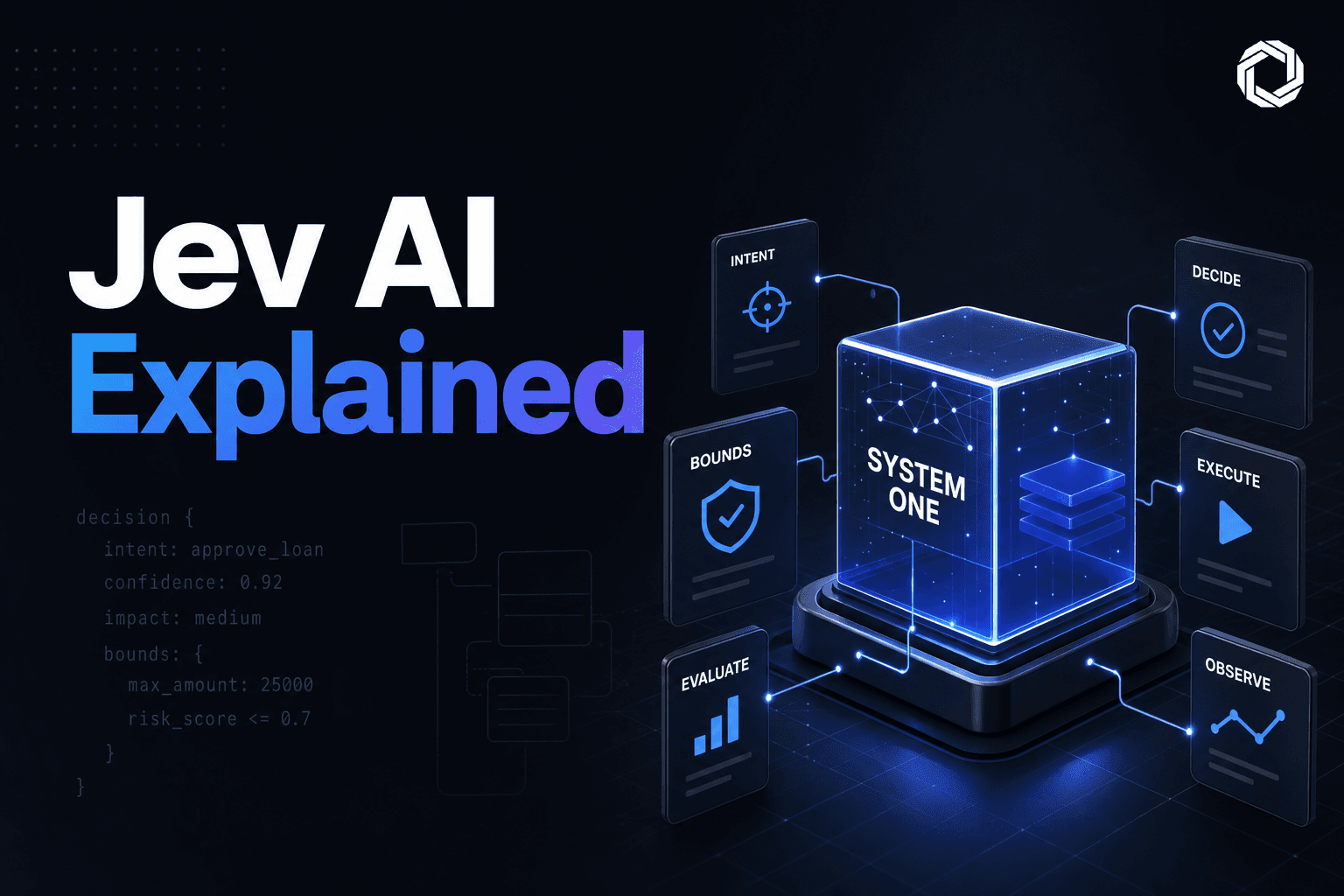
Jev AI is TypeSafe AI's System One model for bounded decisions inside software. Rather than a free‑form chat or a generic text generator, Jev AI takes application state, a small set of typed questions, and returns structured answers that your code can route, score, or use to choose a next step. This distinction matters in product workflows where safety, determinism, and clear contracts between the model and the app matter most. In practice, the system is designed around three core ideas: state, typed questions, and typed answers. The model evaluates each question against the same state and delivers outputs that are machine-readable and actionable, enabling fast, predictable decision paths rather than exploratory text generation. For practitioners, this is the difference between a model that plans and a model that talks. See how this is described in detail in community and official references that frame Jev AI as a System One decision layer: the core primitives are state, typed questions (Choice, Score, Noul), and typed answers.
For readers who prefer a quick orientation, the Hugging Face overview of Jev AI highlights that you provide the current state and a bounded question, and you receive structured outputs to guide subsequent steps in the software workflow. This framing helps product teams design decision points that can be instrumented, tested, and governed inside your enterprise stack. Read more here: Jev AI overview.
References from the community and vendor documentation reinforce the same structure: Jev AI uses a defined state, a bounded set of questions, and typed answers (Choice, Score, Noul) to produce deterministic signals rather than free-form text. This discipline is what makes Jev suitable for decision‑critical components in product platforms and AI-enabled decision workflows. See the official framing and examples here: Jev AI: System One Decisions for Data Agents.
The state, the questions, and the answers in practice
- State: a snapshot of the relevant context for a single decision (e.g., user, ticket, incident context, recent events).
- Typed questions: a small set of bounded question types you define for the workflow. The primary primitives are:
- Choice: a discrete selection from a finite set.
- Score: a calibrated numeric value (often 0–1, sometimes scaled to 0–100).
- Noul: a typed judgment used to capture a qualitative or yes/no/neutral signal in a controlled form.
- Answers: a structured payload that the application can turn into an action, such as routing, triggering a workflow step, or updating data.
You can see the same contract pattern described in third‑party coverage as well, which emphasizes that Jev AI returns structured, typed outputs rather than long natural-language explanations: What Is Jev AI? A Decision Layer for AI Agents.
To ground this further, the InfiniSynapse write‑up explicitly calls Jev AI a System One decision model and details how the three primitives—state, typed questions, and typed answers—drive the bounded decision workflow. This framing is why teams use Jev as a decision layer that sits between stateful software and downstream actions: Jev AI: System One Decisions for Data Agents.
Why System One matters for AI applications
Bounded decisions deliver determinism and faster feedback loops in real apps. In many enterprise workflows you don’t want a model to generate an elaborated plan or long rationale; you want a reliable signal that you can route to an API, a database update, or a human review queue. System One designs aim to constrain the model to a well-defined contract with explicit inputs and outputs, enabling governance, testing, and auditability. The result is a safer, more composable AI component that fits neatly into existing architecture stacks rather than acting as a black box that writes or edits software.
From the perspective of enterprise pragmatism, the bounded decision approach is often preferable to vanilla LLMs for narrow decisions such as triage, prioritization, routing, or risk assessment. The same concept is echoed across independent analyses and vendor explainers of Jev AI as a decision model that produces a calibrated signal (with a confidence score) rather than free text. See a concise description in third‑party coverage: Jev AI Model Explained: What It Means for Market Research.
Moreover, practitioners should anchor these decisions in governance constraints: data boundaries, permissions, privacy and regulatory compliance, and the ability to route outputs to the correct controls in your product. In the InfiniSynapse view, operating controls and explicit boundaries around a decision model are part of the architecture, not an afterthought. This is central to the “System One” premise: you own the decision contract, you observe results, and you have a predictable path to remediation if results drift.
Why System One matters for AI applications (deeper integration perspective)
The core value of System One models in enterprise software is that they reduce risk while accelerating decision cycles. Because the outputs are typed and contract-bound, you can implement strict gating between model outputs and app actions. For example, a high‑risk decision (like changing the state of a critical incident) can require a human-in-the-loop or a formal fallback, while low‑risk decisions can proceed automatically. This separation is essential when you’re integrating AI into production decision workflows that affect customers, data integrity, or regulatory compliance.
Enterprise teams often struggle with the gap between experimental AI and reliable product components. A System One‑driven design helps close that gap by providing:
- Deterministic decision points you can instrument and observe.
- A clear contract between model outputs and downstream actions.
- A path to governance controls, including privacy boundaries and data access rules.
- A practical, scalable pattern for pilots: you can start with a bounded decision (e.g., triage priority) and incrementally extend to additional decision types as you mature.
The literature around Jev AI and System One models aligns with these advantages. In a recent overview, the system’s bounded outputs and calibrated signals are highlighted as differentiators from open‑ended text generation in LLMs. See the overview and empirical framing here: What Is Jev AI? A Decision Layer for AI Agents.
Gaps in current explanations and the original angle
Many public write‑ups describe what Jev AI is in isolation but offer limited guidance on how to integrate it into real apps—how to model state, how to define purposeful questions, how to compose a single, reusable decision contract, and how to connect the result to a live workflow with governance and tests. This article aims to fill that gap with an architecture playbook and a pilot blueprint: a concrete framework for model state modeling, question design, contract definitions, dataflow routing, and layering with conventional tools (code, databases, tools). The emphasis is on verifiability, governance, and measurable outcomes rather than hype.
For additional context on the decision‑layer concept, see Juxtaposed industry descriptions that discuss Jev as a decision layer and System One in practice: Jev AI Overview and Jev AI: System One Decisions for Data Agents.
Architecture playbook: designing Jev-powered decisions
A robust architecture for Jev AI starts with a disciplined design framework. The goal is to define a repeatable pattern that your engineers can implement, monitor, and extend. The playbook below gives a practical blueprint you can adapt to your product concerns and governance requirements.
1) Model state modeling
- Identify decision hotspots in your product where a bounded, repeatable decision can accelerate flow without compromising safety.
- Define the minimum viable state for each decision type. State should be explicit, structured, and versioned so changes don’t silently drift the decision behavior.
- Use a canonical state object that your Jev AI instance consumes, ensuring the same surface is available across all decision types.
Example state concepts to start with:
- User or agent identity and permissions
- The domain object (e.g., a support ticket, incident report, or order) with essential fields
- Recent events or context that might influence the decision (time, history, related items)
- Any privacy/PII controls that constrain what Jev AI can see
2) Crafting purposeful questions (Choice, Score, Noul)
- Map each decision to a minimal set of questions that cover the required decision space while remaining bounded.
- Prefer discrete choices for fast routing and clear contracts; use Score when a calibrated risk or confidence signal is necessary; use Noul for a qualitative, bounded judgment when a binary outcome is insufficient.
- Keep questions stable across iterations to maintain comparability and ease of governance.
3) Defining a single contract for decision outputs
A consistent contract makes it easier to reason about downstream actions, testability, and observability. A typical contract captures:
- decision: a typed value (e.g., a Choice) and the rationale in a structured form if needed
- confidence or score: a numeric signal indicating how sure the model is about the decision
- optional notes or qualifiers (Noul) for additional context
- provenance: a small fingerprint of the input state and question version so you can audit drift
This is the cornerstone that makes Jev AI usable in code paths. The architecture emphasizes that the contract is authoritative for routing and for any human review gates.
A compact illustration of a Decision Contract and a sample state is shown in the code blocks below. The blocks are intentionally small and runnable in principle to demonstrate the pattern without exposing production secrets.
4) Routing results into application workflows
- Build a lightweight routing layer that consumes the Jev AI contract output and translates it into app actions: API calls, database mutations, queue pushes, or UI signals.
- Ensure deterministic routing rules: if the decision is X with high confidence, invoke action A; if Y or low confidence, route to a fallback or human review.
- Instrument the routing with tracing, correlation IDs, and metrics so you can trace decisions end-to-end.
5) Layering with traditional tools
- Preserve data sovereignty by storing the decision inputs, outputs, and state in your existing databases with proper access control.
- Use your existing logging, observability, and incident tooling to monitor Jev AI decisions, including latency, success rate, and drift in decision outputs.
- Integrate with your CI/CD, so decision schemas and question definitions are versioned with the same rigor as code.
Here is a compact illustration to show how a minimal Decision Contract and a supporting state can look, followed by a flow that routes Jev AI results into an action path. The emphasis is on a clear, repeatable pattern you can implement in real apps.
Snippet 1 — minimal decision contract and state (JSON)
{
  "model": "jev",
  "state": {
    "ticket": {"id": "T-12345", "priority": "P2"},
    "user": {"id": "U-678", "role": "agent"},
    "context": {"channel": "web"}
  },
  "question": {
    "type": "Choice",
    "id": "triage_level",
    "options": ["low", "medium", "high"]
  },
  "outputContract": {
    "decision": {"type": "Choice"},
    "confidence": {"type": "Score", "min": 0, "max": 1},
    "notes": {"type": "Noul"}
  }
}
What this demonstrates: a minimal, runnable pattern for a Jev AI decision with a bounded question and a typed, parseable output contract.
Snippet 2 — data flow outline (YAML)
flow:
  - ingest: "ticket data + user intent"
  - jev_ai: "evaluate -> {decision, confidence}"
  - route:
      if: "decision == 'high' and confidence > 0.8"
      then: "update_ticket_priority and notify"
      else: "escalate_to_human_review"
  - persist: "decision + state snapshot"
What this demonstrates: a compact orchestration sketch showing how Jev AI outputs can drive predictable actions and where to insert human-in-the-loop gates when needed.
6) Implementation checklist and common pitfalls
A practical pilot requires a focused checklist to reduce missteps and align with governance. Here is a concrete starter checklist you can adapt to your environment:
- Technical latency and reliability
- Target end-to-end latency budgets that keep decision‑driven workflows responsive.
- Implement retry, backoff, and idempotent routing to prevent duplicate actions.
- Instrument latency and success metrics per decision type.
- Observability and traceability
- Attach correlation IDs to every decision for end-to-end traceability.
- Log input state, question, and output contract in a controlled, privacy-conscious manner.
- Establish alerting on drift in output distributions (e.g., sudden shift in preferred choices or confidence scores).
- Governance and data boundaries
- Enforce data boundary rules so Jev AI only sees the data permitted by policy.
- Define permissions for who can adjust decision schemas and run pilots in non-production environments.
- Implement privacy controls and data minimization aligned with regulatory requirements.
- Risk controls and human-in-the-loop
- Establish a risk tiering model to decide when human review is required.
- Provide escalation paths and clear reversion semantics if a decision leads to unintended outcomes.
- Calibrate and test guardrails in low-stakes pilots before expanding to higher stakes decisions.
- Testing strategy and calibration
- Develop calibration tests that verify the mapping between inputs and outputs remains stable.
- Use synthetic or anonymized data to validate behavior without exposing production data.
- Run edge-case tests to identify unsafe or ambiguous states and refine your state model and questions.
- Architecture pitfalls to avoid
- Overly large, mutable state that makes decisions brittle; keep the state compact and stable.
- Too many questions; start with a small, composable set and iterate.
- Relying on a single model for all decisions; layer Jev AI inside a broader decision fabric with clear handoffs to code, services, or humans.
These guidelines align with industry patterns for decision-aware components and governance in AI systems and map to the core capabilities that System One models advocate. See the foundational notes on Jev AI’s primitives and governance structure in the cited references above.
7) Case study sketch and expected outcomes
To illustrate how this plays out in a real workflow, consider a lightweight support‑ticket triage scenario: a customer raises a ticket and a human agent or an automation layer needs to decide the initial triage category. The Jev AI decision module would receive the ticket state (customer impact, time since submission, related incidents), plus a bounded question such as:
- Question: What triage level should this ticket receive?
- Options: low, medium, high
- Output contract: a Choice for triage level, a Score representing confidence, and a Noul for a qualitative note.
Expected outcomes include:
- Measurable accuracy: alignment between Jev AI triage decisions and eventual human classification in the first 24 hours.
- Latency: end-to-end triage decision within a defined window (e.g., under 200 ms for low-stakes decisions, under 1–2 seconds for higher-stakes workflows).
- Actionability: downstream routing to the correct queue or automation path, visible in ticket dashboards with traceable decision IDs.
- User impact: faster ticket resolution, reduced time to triage, and improved agent focus on high‑value tasks.
This pattern scales from triage to more complex workflows, such as incident response, where bounded decisions are critical to maintaining stability and response speed. The architecture supports incremental expansion: you can add new decision types (e.g., a Score for urgency, a Noul for escalation readiness) while preserving a stable contract interface.
A pilot can be designed around a single decision type (triage level) and a single domain (support tickets) to measure reach, latency, accuracy, and governance compliance before broadening to additional use cases. The pilot blueprint guidance you’ll need is available through our architecture and readiness playbooks, and can be tailored in strategy sessions: you can book a strategy session to tailor a System One decision workflow for your product.
Case study indicators and measurement plan
- Define baseline metrics for the pilot: decision accuracy against human-ground truth, decision latency, and routing correctness.
- Include user impact metrics: time-to-resolution, escalation rate, and customer satisfaction indicators.
- Establish a calibration cadence: periodic re‑training or re-evaluation of the state definitions, answer types, and the distribution of Choice/Score/Noul signals.
- Validate governance posture: ensure data boundaries, privacy controls, and human-in-the-loop gates function as intended.
These practical steps aim to deliver a measurable business impact while keeping the architecture maintainable and governable as you scale.
Putting it all together: architecture playbook at a glance
- Define a compact, versioned state model per decision domain.
- Create a bounded question set using Choice, Score, and Noul—the System One primitives.
- Establish a single, explicit outputs contract that your app can consume deterministically.
- Route outputs into your orchestration layer with clear triggers and human-in-the-loop gates where appropriate.
- Layer Jev AI over existing tooling (databases, APIs, event buses) and monitor end-to-end performance.
- Pilot, measure, and iterate with governance and privacy as ongoing commitments.
If you’re building decision-aware components into enterprise AI platforms, Jev AI provides a practical, governance-friendly mechanism to insert decision logic into software workflows without surrendering control to opaque text generation. For teams ready to start, consider pairing this playbook with an architecture review and API system integration plan to ensure your decision layer fits cleanly into your product stack. See our related service areas for the next steps: AI product engineering, architecture review, API system integrations, and data engineering.
To learn more about the Jev approach and System One primitives, check the external references cited above and consider a pilot blueprint tailored to your product. The pilot blueprint and governance checklists are available for download in the accompanying guide, and you can book a strategy session to tailor a System One decision workflow for your product.
If you want to explore this approach with a live walkthrough, we offer a short strategy session to tailor a System One decision workflow for your product. Download the Jev AI architecture and pilot blueprint checklist or reach out to discuss a pilot in your environment.
Inline external references used to ground the definitions and patterns above include: Jev AI overview, Jev AI: System One Decisions for Data Agents, and Jev AI Model Explained: What It Means for Market Research.
For more detailed background on the System One primitives and their role in decision-aware AI components, you can also review community and vendor-oriented coverage that frames Jev AI as a decision layer with state, typed questions, and typed outputs.
Pilot blueprint download and strategy session options: Our team can tailor the architecture playbook to your product goals, data governance constraints, and risk tolerance. The engagement typically covers a draft decision contract, state model templates, and a pilot plan aligned to your roadmap.