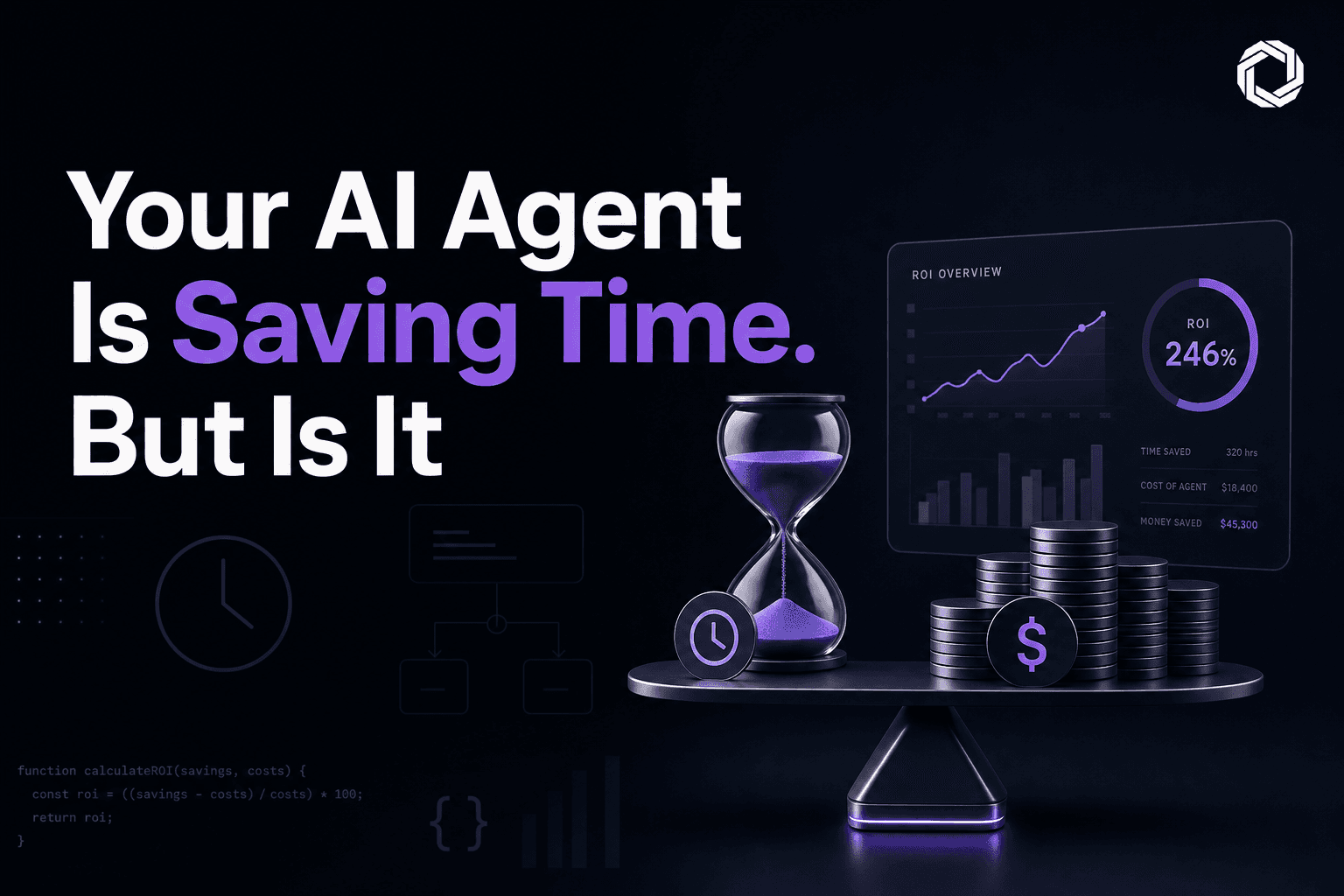
Time savings from AI agents don’t guarantee cost savings. Learn how to measure true ROI, uncover hidden costs, and apply a practical 90-day plan to prove money saved.
Hook: Time saved vs money saved — introducing the ROI lens
Saving time is appealing, but it does not automatically translate into money saved. A practical ROI lens requires a full view of costs, including compute, storage, data transfer, licensing, integration, and ongoing monitoring. The promise of AI agents is compelling, yet research and practitioner discussions show that savings are not automatic and depend on disciplined cost tracking and governance. For example, industry analyses note that ROI hinges on more than faster task completion, and organizations must quantify both savings and all invest-to-operate costs as they scale. Is your AI agent actually saving you money? Here's how to tell illustrates that the savings promise is real but not guaranteed, and it highlights the need for a structured ROI approach. A practical framework also draws on domain experiences that emphasize balancing time gains with cost controls and governance. Time Savings vs Cost Savings: Prioritizing AI Agent Projects offers a structured perspective you can apply to your own 90-day planning. And to ground expectations with real-world data, consider industry observations on cost impact in 2025: How AI Agents Help Businesses Save Time and Money in 2025.
Clarify the ROI framework: total cost of ownership vs direct savings
ROI for AI agents should distinguish between direct savings (labor, throughput) and total cost of ownership (TCO), which includes compute, data storage, data transfer, licensing, integration, and ongoing monitoring. TCO captures the full operating envelope that determines whether automation is financially viable over time, not just the time saved per task. This framing aligns with the broader guidance that effective ROI requires accounting for both what you gain and what you must invest to sustain it. (See the cited ROI framework discussions above.)
The three cost buckets that shape AI ROI
- Direct operational savings: labor redeployment, reduced errors, and throughput gains from automation.
- Hidden costs: compute costs, data storage, data transfer, licensing, and integration toil.
- Opportunity costs and risk: SLAs, rework, compliance, security, and potential outages or latency impacts.
Structured planning helps you surface these buckets early and track them as you roll out AI agents. See the practical framework and case-based guidance that discuss how to balance these buckets in real-world deployments. Prioritizing AI Agent Projects provides a disciplined template you can adapt to your domains. Additionally, real-world data points illustrate how cost considerations can influence outcomes at scale. How AI Agents Help Businesses Save Time and Money in 2025
A practical 90-day ROI framework you can apply today
- Map tasks and processes suitable for AI agents.
- Estimate baseline costs for those tasks today (labor, time, errors).
- Estimate AI gains (time saved, throughput increases, quality improvements).
- Estimate ongoing costs (compute, data, licensing, monitoring, maintenance).
- Compute payback and ROI (payback period, net savings, NPV/IRR concepts).
- Establish governance and reporting to track progress and adjust scope.
A structured, phased approach like this is echoed in practitioner guidance that emphasizes task-level scoping, cost baselining, and governance as you scale AI agents. Prioritizing AI Agent Projects is a practical resource for this 90-day framing. For a sanity-checking perspective during the rollout, a quick diagnostic can help you stay aligned with ROI goals. Quick diagnostic: Are you getting the return you hoped for?
Hidden costs that erode savings (and how to prevent them)
Hidden costs often erode ROI if not actively managed:
- Prompt engineering time and iteration cycles
- Model drift and the need for ongoing retraining or tuning
- Data quality, governance, and lineage requirements
- Monitoring, auditing, and governance overhead
- Latency and downstream impact on user experience
- Integration toil and API/vendor changes
- Licensing changes and price escalations
Preventive steps include setting explicit governance, defining data quality gates, budgeting for maintenance, and building a repeatable RACI for model updates and vendor negotiations. The ROI debate is well captured in industry discussions that stress the need to look beyond immediate task-time reductions. If the math doesn’t add up…
Quick diagnostic: 5-minute ROI sanity check
Use a fast check to sanity-test ROI before broad scaling:
- Do the anticipated savings exceed ongoing costs by a comfortable margin?
- Are data quality, governance, and latency within acceptable thresholds?
- Do you have governance and monitoring in place to detect drift and compliance issues?
- Are you prepared to adjust scope if cost overruns appear?
This quick diagnostic approach is described by sources focusing on rapid ROI validation and early warning signs of misalignment. Quick diagnostic: Are you getting the return you hoped for?
Domain benchmarks and counterexamples
ROI is not one-size-fits-all. Domain benchmarks show a range of outcomes, with some projects delivering meaningful cost reductions and others illustrating overhyped expectations. Industry analyses and practitioner reports highlight variability by domain, calling out both success stories and missteps to contextualize expectations. For example, 2025 analyses summarize potential cost and time benefits, while other sources emphasize careful governance and cost controls as prerequisites for upside. How AI Agents Help Businesses Save Time and Money in 2025
KPIs, tools, and the 90-day action plan
Key performance indicators (KPIs) to track ROI include payback period, net savings, total cost of ownership, mean time to repair (MTTR), and downtime. Use a reusable ROI calculator or template to standardize calculations across domains and programs. In practice, monitoring these KPIs over a 90-day window helps you decide whether to scale or pause AI agent initiatives. Our 90-day plan is designed to be repeatable and adaptable to different domains, with milestones tied to cost and value evidence derived from the framework above.
Next steps: how to implement and get expert help
- Run a tailored ROI review with our team to validate your 90-day plan and ROI calculator inputs.
- Download our ROI template to start your 90-day ROI calculations today.
- Book a guided assessment with our specialists to tailor the framework to your business and domain needs.
Note: The guidance and data points referenced above reflect ROI and cost considerations observed in practitioner literature and industry discussions cited here for coverage and accuracy. For hands-on alignment, consider engaging with a dedicated ROI review to translate this framework into your domain-specific plan.