AI agents are powerful alone, but they shine when they connect to tools and each other. This guide breaks down MCP, A2A, and ACP — the protocols behind agent communication — and when to use each.
Understanding How AI Agents Communicate
AI agents have come a long way, but a single agent working in isolation can only do so much. The real breakthroughs happen when agents connect to external tools and collaborate with other agents. That raises a key question for anyone building AI systems today: how should agents actually communicate?
Three protocols have emerged to answer that question — MCP, A2A, and ACP. Understanding what each one does, and when to reach for it, is quickly becoming essential knowledge for developers and technical teams working with agentic AI. Here is a practical breakdown.
MCP: Connecting Agents to Tools
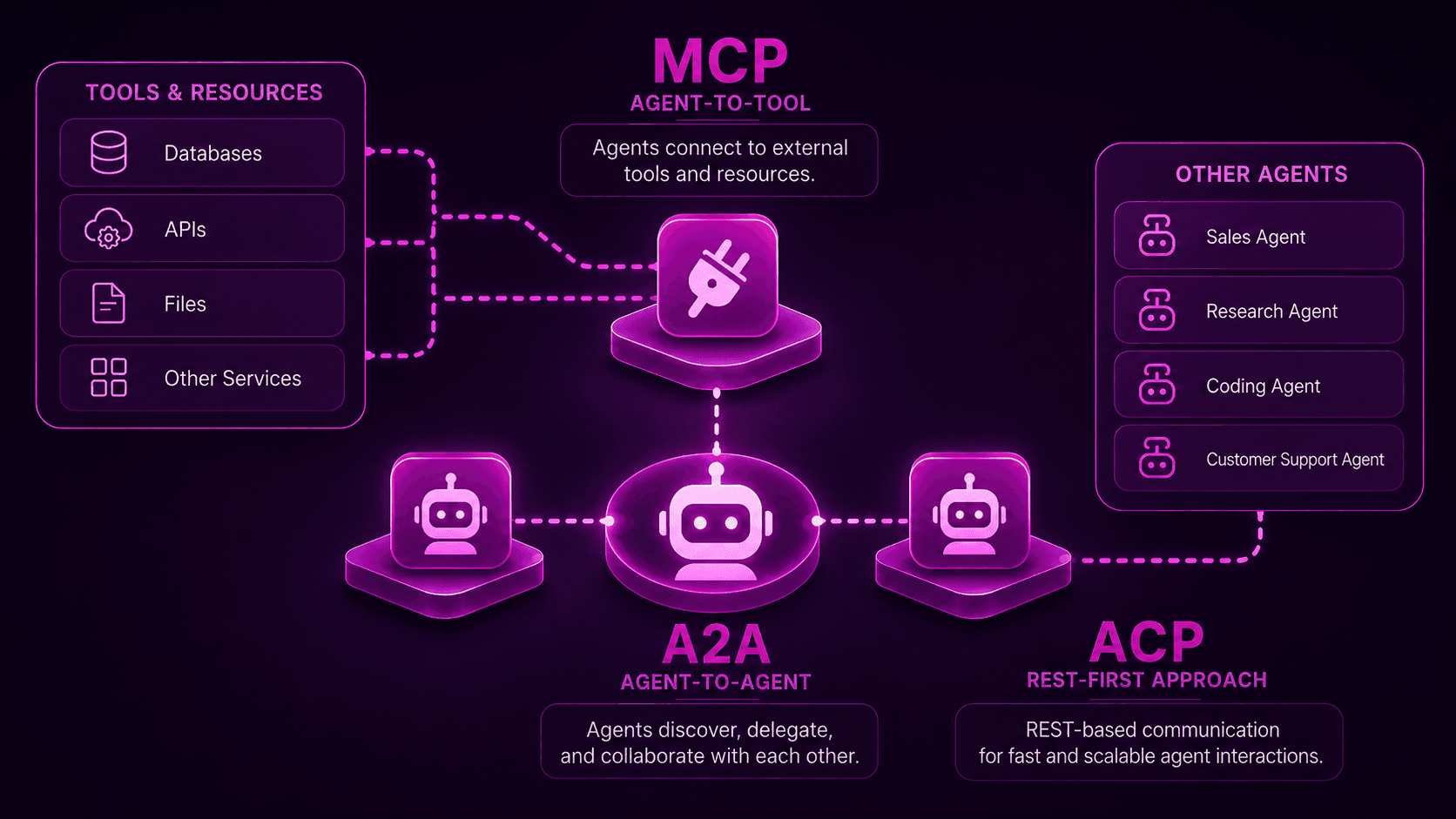
The Model Context Protocol (MCP) handles agent-to-tool communication. When a user makes a request, the host application's built-in MCP client formats it and routes it to the correct MCP server. That server executes the tool call and returns a structured response, which the agent then uses to keep reasoning. In short, MCP is how an agent reaches out to databases, APIs, files, and other external resources in a consistent, structured way.
A2A: Letting Agents Talk to Each Other
The Agent-to-Agent (A2A) protocol governs communication between agents. When an agent cannot finish a task on its own, it discovers a capable peer through that peer's Agent Card, published at a well-known URL. It delegates the task and receives a structured result in return. If the second agent needs more information partway through, it enters an input-required state, pauses, and loops back to the first agent — making A2A well suited to multi-step, collaborative workflows.
ACP: The REST-First Approach (Now Merged into A2A)
The Agent Communication Protocol (ACP) tackled agent-to-agent communication with a REST-first design. Peers were discovered through an Agent Manifest and called directly over HTTP, responding synchronously for low-latency tasks or asynchronously via an SSE stream for longer ones. ACP has since been merged into A2A, but its REST-oriented ideas remain a useful way to think about agent interoperability.
How They Work Together in Production
In real-world deployments, MCP and A2A are not competing standards — they are complementary. MCP handles tool access, while A2A handles agent-to-agent communication. Most production-grade agent stacks end up running both side by side: agents use MCP to reach the tools and data they need, and A2A to coordinate with other agents on tasks too complex for any single one to handle.
Final Thoughts
As AI agents move from demos into production, the protocols connecting them matter as much as the models themselves. Knowing when to use MCP for tools and A2A for agent collaboration is a foundational skill for building reliable, scalable agentic systems. Are you already running MCP and A2A together in your stack? It may be time to start.