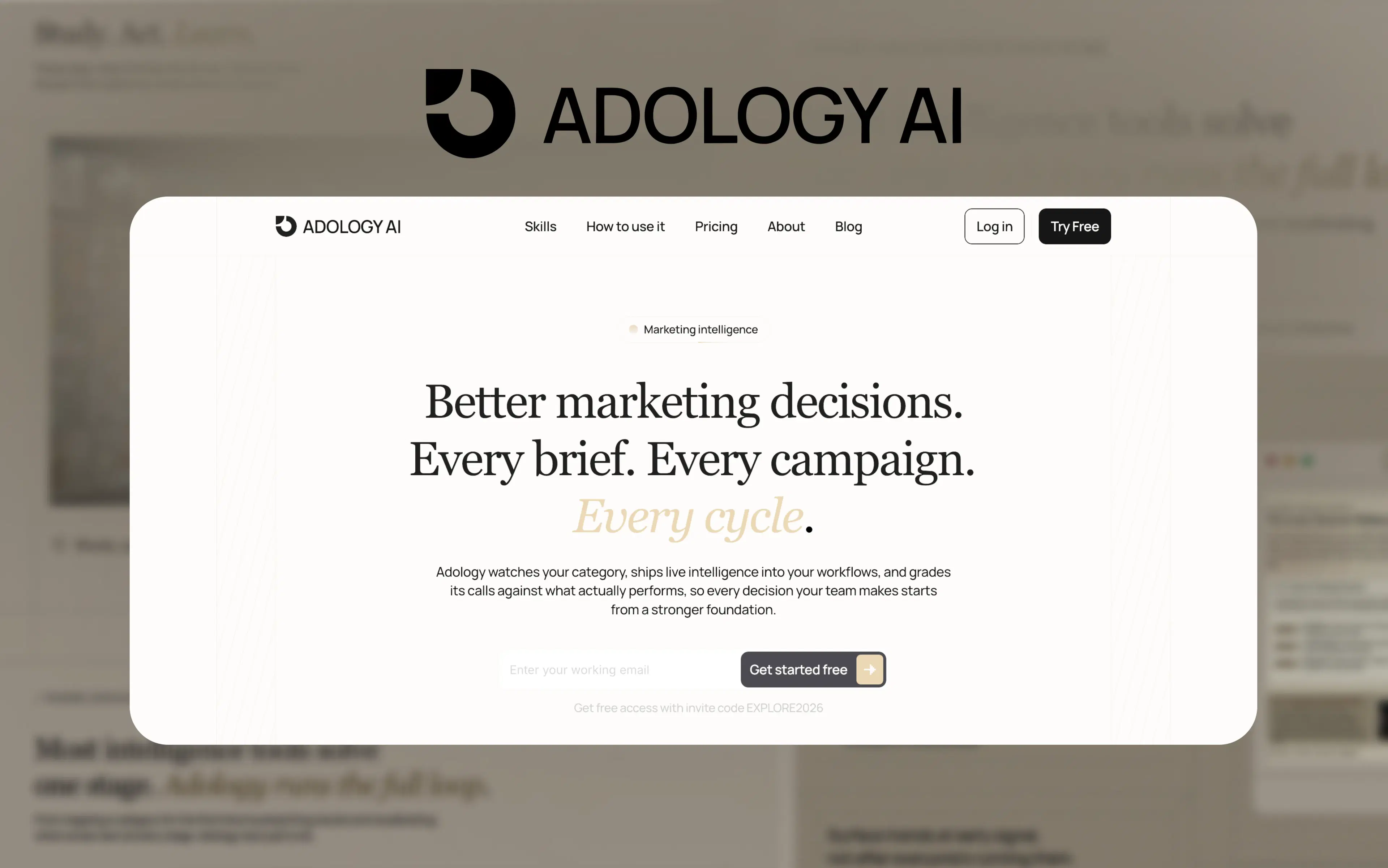
Adology: Agentic Intelligence Platform for Creative Analytics
A 92-tool AI analyst that answers marketers in plain language, over ad creative pulled from nine platforms, with every LLM call metered and capped.
- TypeScript
- Node.js
- PostgreSQL
- pgvector
- AWS EKS
- Temporal
- DBOS
- AI Agents
- AdTech
- React 19
- tools in the Scout agent registry
- 92
- PostgreSQL tables across 139 migrations
- 132
- redundant calls a day removed by one scan lock
- ~717,000
The challenge
Creative data was trapped in unstructured media across 9 platforms. Scaling multimodal LLM analysis created strict multi-tenancy, sub-second latency, and critical cost-control constraints.
What we built
End-to-end platform: Scout agentic analyst with 92 tools, multi-tenant ingestion pipeline across 12 scraper networks, vector search with pgvector, and strict cost-governance reliability systems.
Systems delivered
- Scout Agentic Analyst
- Multi-Tenant Ingestion Pipeline
- Multimodal LLM Enrichment & Taxonomy Labeling
- Hybrid Retrieval Engine (pgvector + Full-Text)
- Cost Governance & Reliability Guardrails
Outcome
Delivered a 15-package TypeScript monorepo with 132 tables, automated health checks, sub-second non-LLM latency, and governed, cost-capped AI workflows.
The full case study
Client context
Adology ingests advertising and social creative from a dozen scraper networks. It enriches each asset with LLM analysis, labels it against taxonomies the customer writes, and lets marketers question the whole corpus in plain language.
Techlusion built the platform end to end. That covered the agent layer, the ingestion and labeling pipeline, the multi-tenant data platform, and the reliability and cost systems that keep an LLM-heavy product affordable to run.
- Industry
- AdTech: marketing and creative intelligence
- Stage
- Agentic analytics product, built end to end
- Team
- Techlusion pod covering backend and data, AI agents, frontend, cloud and DevOps, plus a delivery lead
- Engagement
- 2025 to 2026
Creative data locked inside video and images
The ads and organic posts that show what a brand and its competitors are doing arrive as video, images and captions across nine platforms. Conventional analytics cannot read that media. Reading it at scale means running multimodal models over every asset, which turns an analytics product into a cost-control problem.
Three constraints shaped every decision. The platform is multi-tenant, so one customer's competitor research has to be provably invisible to another. Anything that does not call an LLM must finish in under a second, and every pipeline layer needs its own spending cap, because an unbounded retry loop against a frontier model is a financial incident.
Adology chose an agentic design over a dashboard of pre-computed metrics. A conversational analyst with direct tool access to the live corpus needs a much stronger substrate underneath it, and that is what the Techlusion pod was engaged to build.
Agent, pipeline and guardrails as one system
The work ran as three streams: Scout, the agentic analyst; ingestion, labeling and the multi-tenant data platform; and reliability with cost governance. Everything lives in a type-safe TypeScript monorepo of 15 packages on Node.js 24, Express 5 and PostgreSQL with pgvector.
Scout runs on the Vercel AI SDK. The platform calls Anthropic Claude, Gemini on Vertex AI, OpenAI and Grok, and orchestration uses Temporal, with a staged move to DBOS under way so each workflow family moves only once its replacement is proven.
A five-stage data path
Customers connect portfolios of brands, influencers, searches and discussions, plus ad accounts through OAuth and ELT. Twelve Apify networks across nine platforms feed one item spine, enrichment adds multimodal analysis, embeddings and taxonomy labels, and retrieval runs parallel lanes over vector similarity, full-text ranking and label filters.
Isolation enforced in the database
Tenant isolation uses PostgreSQL Row Level Security, proven continuously by isolation assertions, a live canary and per-team fixtures. Scoped denials return 404 instead of 403, so a resource's existence never leaks to another tenant.
Inside Scout and the ingestion platform
Scout is a 92-tool agent driven by a 3,522-line orchestrator. It runs a bounded multi-step loop over a registry that covers retrieval, aggregation and analysis, chart and artifact authoring, pipeline control and external research.
Prompts assembled per turn
Each turn combines a base prompt with 34 gated skill modules. The customer's own authored context sits on top as a separate layer with explicit precedence.
Guards for every agent failure mode
Loop and repetition detection, cost guards, tool-call repair, stream heartbeats and result compaction each have a dedicated guard. Two-layer cancellation races every tool execution, so pressing Stop responds immediately.
Memory that stays in its workspace
Per-user memory lives in PostgreSQL and is cached in Valkey. Each fact records the portfolio it was learned in, so knowledge never crosses workspaces, and prompt tokens are attributed per segment.
Labeling that never pays twice
The default gap-fill mode labels only item and category pairs that no taxonomy version has covered yet. An explicit supersede mode re-labels at full cost, and judge-agreement analysis plus correction capture feed back into taxonomy revisions.
Five queues, each with its own limits
Work flows through run, source, download, analysis and embed queues. Each queue is throttled on its own cost and rate-limit profile, so one slow stage never becomes a shared bottleneck.
One contract for about 350 endpoints
Roughly 350 endpoint registrations across 96 modules go through a single schema-driven handler factory. It composes auth, validation, authorization and response envelopes in a fixed order, so new endpoints inherit the full security posture.
What shipped across the platform
The delivered platform has 132 PostgreSQL tables under 139 migrations, 1,445 test files, and sub-second latency on everything that does not call an LLM. The web app is a React 19 and React Router 7 SSR application with 614 components and 130 route modules, covered by Playwright, plus an internal admin platform on TanStack Start with a type-safe oRPC layer.
Guardian runs about 30 health checks across 47 modules, from cost drift and spend reconciliation to schema drift and credential expiry, and sends a plain-language weekly digest. LLM spend is tracked in Valkey with a monthly budget, a circuit breaker and an anomaly shutdown, and a single-flight scan lock removed about 717,000 redundant calls a day against the primary writer.
An MCP server exposes 28 tools to external AI clients. Releases go through Helm to AWS EKS across three managed environments with automated migrations, health-gated rollouts and rollback on failure, and 20 CI workflows gate every change.
Tech stack
AI and agents
- Vercel AI SDK
- Anthropic Claude
- Gemini on Vertex AI
- OpenAI
- Grok
- MCP server
Backend and data
- Node.js 24
- TypeScript 5.9
- Express 5
- Zod
- oRPC
- PostgreSQL
- pgvector
- Drizzle ORM
- Row Level Security
- MongoDB
- Valkey / Redis
- Temporal
- DBOS
- Apify
Frontend
- React 19
- React Router 7
- TanStack Start
- Tailwind CSS 4
- Radix UI
- Recharts
- Playwright
Cloud and operations
- AWS EKS
- Helm
- KEDA
- Docker
- GitHub Actions
- Prometheus
- Sentry
- PostHog
- Turborepo
- Vitest
Integrations
- Stytch B2B
- Stripe
- Fivetran
- DataForSEO
- Brave
- GDELT
- AWS S3 and KMS
Services used
- AI Product EngineeringScout, the 92-tool agent, its prompt system and its failure guards.
- Data EngineeringTwelve-network ingestion, staged queues, enrichment and hybrid retrieval.
- Cloud & DevOpsHelm releases to AWS EKS, 20 CI workflows and the Guardian health checks.
- IndustryMedia & EntertainmentAd tech and creative analytics for marketing teams.
Questions about this project
How long did the Adology engagement take?
The engagement ran across 2025 and 2026. Techlusion built the platform end to end in that period, and the move from Temporal to DBOS was still being staged one workflow family at a time.
What tech stack does Adology run on?
A TypeScript monorepo of 15 packages on Node.js 24 and Express 5, PostgreSQL with pgvector and Row Level Security, Valkey, React 19 with React Router 7, and Temporal and DBOS for orchestration, deployed with Helm to AWS EKS.
Which AI models does the platform use?
The stack lists Anthropic Claude, Gemini on Vertex AI, OpenAI and Grok. Scout itself runs on the Vercel AI SDK with 92 tools and 34 gated skill modules.
How does Adology keep LLM costs under control?
Every pipeline layer has its own cap. Spend is tracked in Valkey against a monthly budget with a circuit breaker, gap-fill labeling never re-pays for a covered cell, and a documented kill switch can stop LLM calls globally, per team or per source.
Figures are derived from the codebase as reported in the case-study PDF. Team composition reflects the engagement as described by the client.
Download the PDF version for your team
The same case study as a formatted PDF, ready to forward to your CTO or add to a vendor review.
Have a similar product challenge? Let's talk about the right technical path.
Discuss a Similar Build