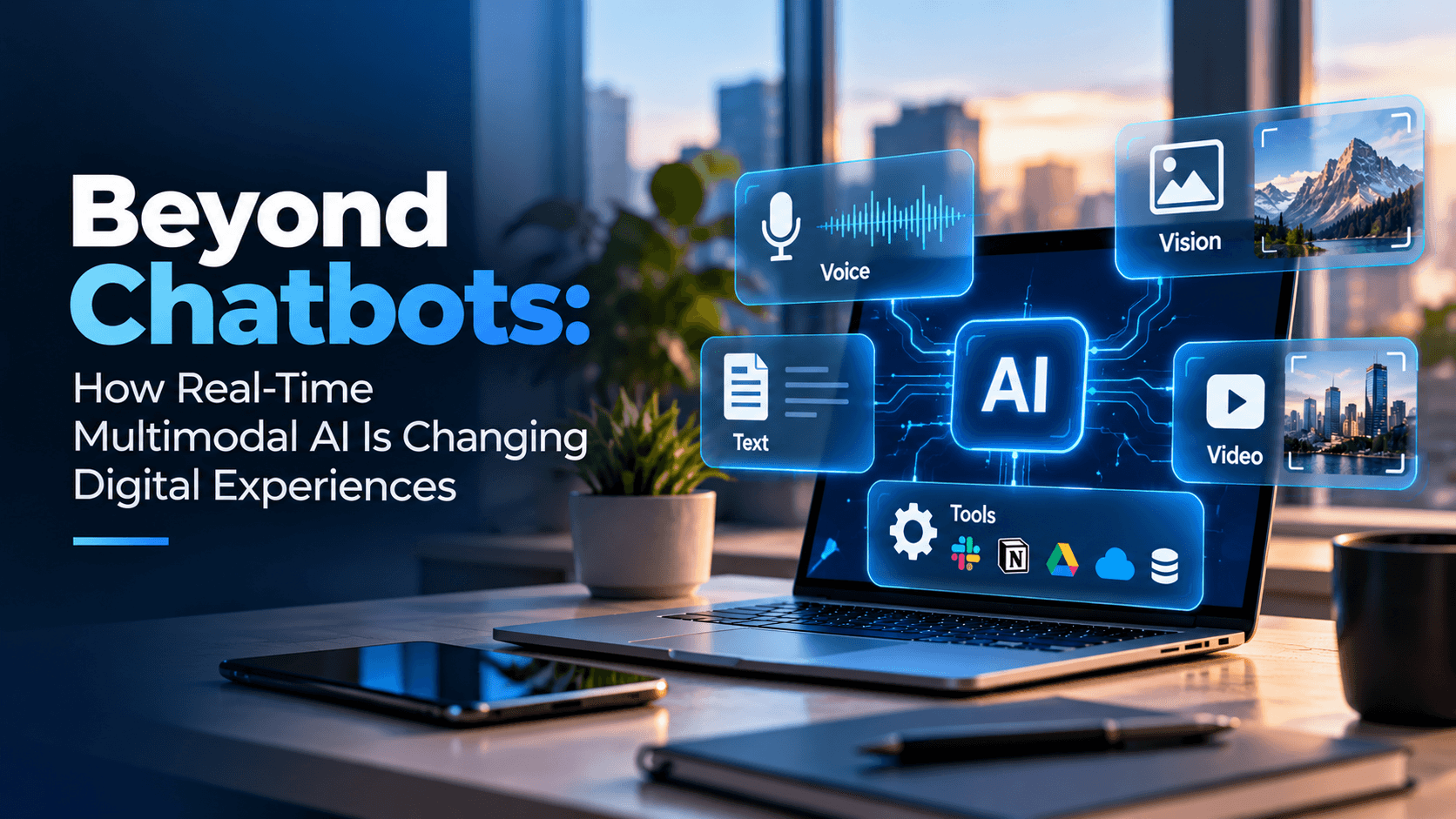
Real-time multimodal AI is moving beyond text chat by combining voice, vision, video, and tool use to create more natural and interactive digital experiences.
What Is Real-Time Multimodal AI?
Multimodal AI can process more than one type of information.
Instead of working only with text, a multimodal system may understand:
- Voice
- Images
- Video
- Text
- Documents
- Screen content
- Environmental context
Real-time multimodal AI adds another important element: speed.
The system processes continuous streams of information and responds quickly enough to support natural interaction.
Google's Live API, for example, supports continuous audio, image, and text streams for low-latency voice and vision interactions.
This allows AI to understand what a user is saying while also considering what the user is looking at or showing to the system.
Why Text-Only AI Is No Longer Enough
Text remains extremely useful.
But many real-world interactions depend on much more than written language.
Human communication naturally includes:
- Tone of voice
- Visual context
- Facial expressions
- Timing
- Gestures
- Surroundings
Consider technical support.
A customer may struggle to explain a hardware problem through text.
With multimodal AI, they could show the device through a camera while describing the problem verbally.
The AI could analyze both inputs together and provide guidance based on what it sees and hears.
This creates a more natural interaction than repeatedly describing visual details in text.
Voice AI Is Becoming More Natural
Traditional voice assistants often feel structured.
The user speaks.
The system waits.
The system responds.
Modern voice AI is moving closer to natural conversation.
OpenAI's GPT-Live, released in July 2026, is designed for real-time voice interaction, while its updated voice architecture supports more continuous conversation rather than relying entirely on rigid turn-taking.
Google's Gemini 3.8 Live similarly focuses on fluid spoken interaction and can continue conversations while handling some tasks in the background.
Important improvements include:
- Faster responses
- Natural interruptions
- Better conversational timing
- Context preservation
- Background tool use
- Multilingual support
Voice is therefore becoming a practical user interface rather than simply an accessibility feature.
Vision Gives AI More Context
Voice tells AI what a user says.
Vision helps AI understand what the user is seeing.
Real-time vision can allow AI systems to interpret:
- Products
- Interfaces
- Documents
- Physical environments
- Equipment
- Screens
- Visual problems
For example, instead of asking:
“Which button should I press?”
A user could simply show the screen.
The AI could understand the interface visually and respond based on the actual context.
This creates new possibilities for:
- Technical support
- Education
- Training
- Field services
- Retail
- Accessibility
- Product onboarding
The value comes from reducing the amount of context the user needs to explain manually.
Live AI Avatars Add a Visual Presence
One of the newest developments is the combination of conversational AI with generated visual avatars.
Google's Live Avatar feature adds synchronized video, facial expressions, speech, and visual presence to Gemini 3.8 Live. Google says the system can adapt speech and lip synchronization across 97 languages.
This creates new possibilities for digital experiences where visual presence matters.
Examples could include:
- Virtual customer-service representatives
- Digital receptionists
- Training assistants
- Interactive guides
- Sales assistants
- Education platforms
The important change is psychological as well as technical.
Users are no longer interacting only with an invisible model.
They may interact with a visible digital character representing a brand or service.
AI Can Continue Working While the Conversation Continues
A particularly important development is asynchronous tool use.
Traditional AI workflows often pause while the system retrieves information or performs an action.
Newer systems can sometimes continue the conversation while other operations happen in the background.
Google demonstrates this with Gemini 3.8 Live performing tool calls while maintaining an active dialogue.
Imagine a hotel assistant.
A guest asks to check in.
Instead of going silent while retrieving the reservation, the AI could continue explaining hotel services while the booking system is queried.
The interaction becomes:
Conversation + Tool execution + Context updates
rather than:
Question → Wait → Action → Response
That difference could make AI interfaces feel significantly more natural.
Business Use Cases for Real-Time Multimodal AI
Real-time multimodal AI could support several practical business scenarios.
Customer Support
Users could explain issues verbally while showing products, screens, or equipment.
Retail
AI shopping assistants could answer questions while analyzing products or customer preferences.
Education
Students could speak naturally, show their work, and receive interactive guidance.
Field Services
Technicians could show equipment while an AI system identifies components or suggests next steps.
Travel and Hospitality
Virtual assistants could manage bookings, provide information, and interact through voice or visual interfaces.
SaaS Products
Software platforms could replace complex navigation with conversational commands.
The common pattern is simple:
The user provides natural context, and the AI adapts the interface around it.
SaaS Products May Need a New Interface Strategy
For years, software products have been designed primarily around:
- Buttons
- Forms
- Menus
- Dashboards
- Search boxes
Multimodal AI adds another layer.
Users may increasingly interact with software by saying:
“Show me why revenue dropped last week.”
or:
“Find the customers at risk and summarize the main reasons.”
The application can still display charts and dashboards.
But the AI becomes another way to navigate the product.
Future SaaS interfaces may therefore combine:
Traditional UI + Voice + Vision + AI agents + Automation
This does not mean graphical interfaces disappear.
Instead, the interface becomes more flexible, which makes [UI/UX design](/services/ui-ux-design) a harder problem rather than a smaller one.
Users can choose the most natural way to interact with the product.
Privacy, Reliability, and Trust Become More Important
More natural AI interaction also introduces more responsibility.
A system processing live audio and video may handle significantly more sensitive information than a text chatbot.
Businesses need to consider:
- User consent
- Data retention
- Identity protection
- Access control
- Recording policies
- Model accuracy
- AI-generated video transparency
- Tool permissions
Google says Live Avatar output includes SynthID watermarking designed to help identify AI-generated audio and video.
Watermarking is useful, but it does not solve every trust problem.
Organizations still need clear policies around how AI systems capture, store, and use multimodal information. This is where [security-aware engineering](/services/security-aware-engineering) matters most, because consent and retention decisions are far cheaper to make before a system is handling live audio and video than after.
The more human an AI experience feels, the more important transparency becomes.
Conclusion
AI interfaces are moving beyond text.
Real-time multimodal systems can increasingly listen, see, speak, reason, use tools, and maintain conversations while completing other tasks.
Recent developments such as Gemini 3.8 Live, Gemini Live Avatar, and GPT-Live show that major AI platforms are investing heavily in more natural, real-time interaction.
For businesses, this does not mean every application needs a voice assistant or digital avatar.
The real opportunity is identifying situations where multimodal interaction removes friction.
If users currently struggle to explain what they need, navigate complex interfaces, or switch repeatedly between tools, real-time AI may create a better experience.
The next generation of AI products may therefore be defined not only by how intelligent the model is, but also by how naturally people can interact with it.
How Techlusion Helps
Techlusion works across [AI & Agentic Systems](/services/ai-product-engineering), Product Engineering, [UI/UX Design](/services/ui-ux-design), SaaS, [Custom Software Development](/services/custom-software-development), [Cloud & DevOps](/services/cloud-devops), and [Data & Automation](/services/data-engineering).
We help businesses evaluate emerging AI technologies and turn them into practical digital experiences that fit real product and operational requirements.
Design AI Around the User Experience
The strongest AI product is not necessarily the one with the most features.
It is the one that makes interaction easier, faster, and more useful for the people using it.